

B7 Switch/Up Position = Digital Meter and RS-232:
When B7 is not set (switch in up position, open), module will function as Digital Meter. The
B7 switch is checked for position when module is turned on, so switch setting should be changed
only when module is off. Changing the switch setting while module is powered will not change
functionality of module.
Usage
Switch B7 In up position (Unset) selects Digital Meter mode with RS232 (serial) output mode
In this mode, module has four options that may be selected using the switches on the back of
the circuit, see Figure below.
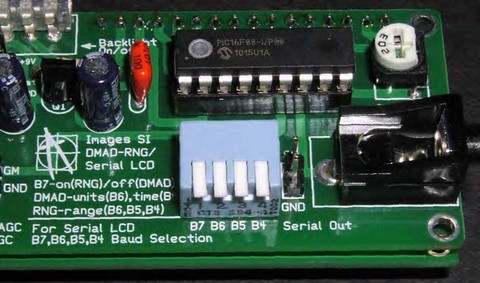
| Switch Table | ||||
| B7 | B6 | B5 | B4 | Function |
| Up | Up | XXX | XXX | mR/hr |
| Up | Down | XXX | XXX | mSv/hr |
| Up | XXX | XXX | Down | 60 Seconds |
| Up | XXX | XXX | Up | 1 Second |
| Up = unset Down = set XXX = Doesn't Matter | ||||
Switch B6 sets whether the output radiation level is given in conventional
terms mR/hr (milliRads/milliRem per hour) or System International (SI) mSv/hr
(milliSiverts per hour).
Switch B4 sets the timing mode of either one minute or one second. When B4 is set to oneminute
mode, the radiation level is given in μR/hr or μSv/hr. This mode is convenient for
checking the local background radiation.
Irrespective of the selection of CPS/CPM, CPS data will be sent out serially every second,
which can be interfaced with PC for Graphing & Charting Purpose. The RS232 interface adaptor
sends the counts per second information transmitted in two bytes. A high byte, that is multiplied
by 256 and added to the low byte for the total count.
Geiger Counter Graphing & Logging Software
Geiger Counter measurements can be used for Graphing & Logging purposes by connecting
Analog Geiger Counter to PC via this module, using various PC Softwares. Two such softwares
are available on Images SI website.