
Kirlian Photography:
What It Is, How It Works, and What It Shows
Explore the process, history, photographic methods, and questions surrounding Kirlian images.
- 1. What Is Kirlian Photography, and What Does It Record?
- 2. What Is the History of Kirlian Photography?
- 3. What Is a High-Voltage Corona Discharge?
- 4. How Are Kirlian Images Made with Film and Digital Cameras?
- 5. What Equipment Is Needed, and What Safety Precautions Are Required?
- 6. Why Do Kirlian Images Vary?
- 7. What Is the Phantom-Leaf Effect?
- 8. Does Kirlian Photography Show an Aura or Life Force?
- 9. Can Kirlian Images Reveal Health or Emotion?
- 10. How Is Kirlian Photography Different from Modern Aura Photography?
- 11. How Is Kirlian Photography Used in Art and Scientific Study?
1. What Is Kirlian Photography, and What Does It Record?
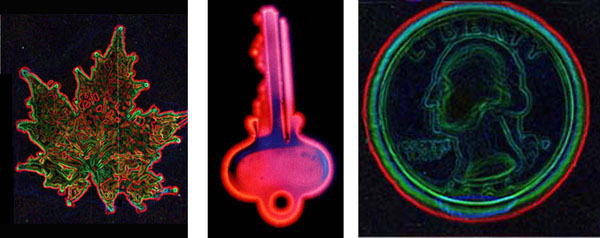
This technique captures the corona discharges surrounding objects when exposed to high voltages. Its unique ability to visualize what some interpret as auras has led to both intrigue and skepticism within the scientific community and the general public alike. While some see potential applications in medical diagnostics and alternative healing practices, others dismiss it as pseudoscience. This page delves into the origins, scientific principles, controversies, and applications of Kirlian photography, shedding light on this enigmatic technique for those curious about its processes and implications.
In practice, the process uses high-voltage, low-current electricity to create a corona discharge around an object. The faint glow can expose photographic film or be recorded digitally. Although the technique is named after Semyon and Valentina Kirlian, who studied and developed it over many years, they did not originate the method.
A Kirlian photograph records light and other photographic effects produced by the corona discharge during an exposure. The resulting pattern depends on the object and exposure conditions, including moisture, conductivity, pressure, spacing, and electrical settings. The image shows the discharge under those conditions; by itself, it does not establish that the pattern represents a separate energy field or has a particular meaning.
2. What Is the History of Kirlian Photography?
The history of Kirlian photography began long before the Kirlians. In 1777, German physicist Georg Christoph Lichtenberg observed branching patterns formed when high-voltage sparks struck insulating surfaces.
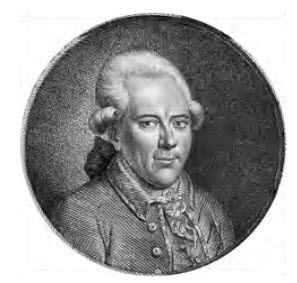
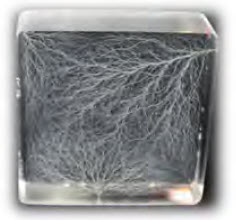
Lichtenberg made the patterns visible by dusting the surfaces with fine powder. These became known as Lichtenberg figures. Photography did not yet exist, but Lichtenberg’s observations showed that electrical discharges could create visible, structured patterns.
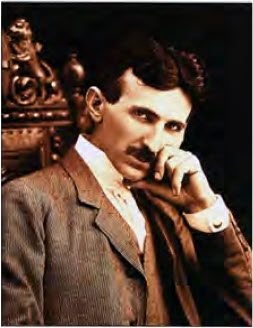
In 1880, Nikola Tesla photographed corona discharges using his Tesla coil.
By the late 1800s, photographic plates made it possible to record faint light and electrical discharges. In the early 1890s, physicist Fernando Sanford photographed coins and other metal objects on photographic plates. Their glowing fringes, which Sanford initially regarded as a flaw, were produced by corona discharge. In 1896, Popular Science Monthly published photographs of electrical discharges.
Other experimenters also explored electro-photography. In the early 1900s, Russian engineer and electrical researcher Yakov Narkevich-Todka exhibited electro-photographs. Around the same period, Dr. F. Strong of Tufts University Medical School used a Tesla coil to make electro-photographs of a hand. Percival G. Bull’s book Simple Experiments in Static Electricity introduced electric-photography experiments to amateur readers.
In 1939, Russian electrician Semyon Kirlian noticed flashes of light between a patient’s skin and an electrode during a demonstration of a high-frequency electrotherapy device. He wondered whether he could photograph the light. He replaced the machine’s glass electrode with a metal one and used his own hand as the subject, capturing the corona discharge. Semyon and Valentina Kirlian then spent more than 30 years refining equipment and studying electro-photographs of living tissue and inanimate objects.
The Kirlians’ work reached a wider American audience through the 1970 book Psychic Discoveries Behind the Iron Curtain, by Sheila Ostrander and Lynn Schroeder. Their work helped popularize the technique. From then on, electro-photography of this kind became widely known as Kirlian photography. The Kirlians refined and publicized a phenomenon that had been observed and photographed before their work.
Timeline of a Forgotten Discovery
- 1777: Georg Christoph Lichtenberg discovers branching electrical patterns, now called Lichtenberg figures, on insulating surfaces.
- 1891–1894: Fernando Sanford conducts electric-photography experiments at Stanford. Coins produce glowing halos from corona discharge. He publishes his findings in Physical Review in 1894.
- 1896: Popular Science Monthly publishes “Photographing Electrical Discharges,” featuring spark images on photographic plates.
- About 1900–1904: Percival G. Bull’s book Simple Experiments in Static Electricity teaches amateurs to make corona-discharge photographs.
- 1939: Semyon and Valentina Kirlian refine high-frequency techniques and popularize what becomes known as Kirlian photography.
3. What Is a High-Voltage Corona Discharge?
Corona-Discharge Spectra
Dry air is composed mainly of nitrogen (about 78%) and oxygen (about 21%). In a corona discharge, energetic electrons collide with air molecules and excite them. Excited nitrogen molecules emit light as they return to lower-energy states. Much of the emission is in the ultraviolet, with strong bands in the near-ultraviolet and violet portions of the spectrum. The visible part of the discharge often appears blue or violet.
The light recorded in Kirlian photography comes from the discharge around the object. Its appearance depends on the discharge and the imaging setup; the colors in a photograph do not necessarily match the spectrum emitted by the gas.
How a Corona Discharge Begins
When the high voltage is applied, free electrons already present in the discharge region - or supplied by the negative electrode or nearby surfaces - are accelerated by the electric field. Their collisions with air molecules can release additional electrons, starting an avalanche that may develop into a corona or streamer discharge.
In Kirlian photography, a finger is placed against or near the film or imaging surface, above an electrode. A thin air gap may remain around parts of the finger. Moisture, salts, oils, pressure, and other surface conditions can affect the object’s electrical contact and the resulting discharge. These conditions can change the pattern recorded in the image.
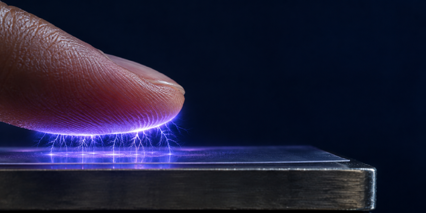
Corona Formation in Kirlian Photography
Corona and streamer discharges are complex. The explanation below describes some basic processes; actual discharge formation depends on the electrode arrangement, surface materials, voltage waveform, polarity, and surrounding conditions.
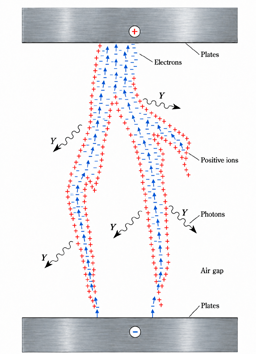
When the electric field becomes strong enough in a region of air, a discharge may begin near an electrode or along an insulating surface. A streamer is a rapidly propagating, branching region of ionized gas. In Kirlian photography, streamers can produce the fine lines or filaments seen around an object.
The following values are examples of voltage and gap settings reported for a particular type of arrangement. They are not universal streamer-onset thresholds. The voltage needed to produce a discharge depends strongly on electrode shape and spacing, the voltage waveform, polarity, and the materials in the setup.
| Voltage | Distance |
|---|---|
| 2,500 V | 0.06 in |
| 5,000 V | 0.12 in |
| 7,500 V | 0.25 in |
| 10,000 V | 0.50 in |
Electrode shape matters. For example, pointed electrodes concentrate the electric field more strongly than broad, smooth electrodes. As a result, two pointed electrodes may produce a discharge across a different gap than two flat plates at the same voltage.
As electrons collide with air molecules, some collisions excite molecules, which can then emit light. Other collisions ionize molecules, releasing additional electrons and creating positive ions. The new electrons can cause further ionization, increasing the number of charged particles.
In air, oxygen also affects how the discharge develops: free electrons can attach to oxygen molecules and become negative ions. In some positive streamers, ultraviolet photons produced in the discharge can help create new electrons ahead of the advancing ionization front. The combined processes allow streamer channels to grow and branch.
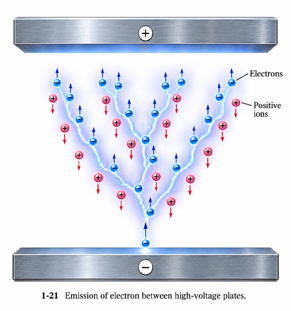
Positive ions move much more slowly than free electrons in the electric field. They generally drift toward the negative electrode, while electrons drift toward the positive electrode. A streamer, however, is a moving ionization front, not simply a column of ions following the electrons. Its shape and direction of growth depend on the polarity and geometry of the electrodes.
For setup and safety information, see the transparent discharge plate manual.
4. How Are Kirlian Images Made with Film and Digital Cameras?
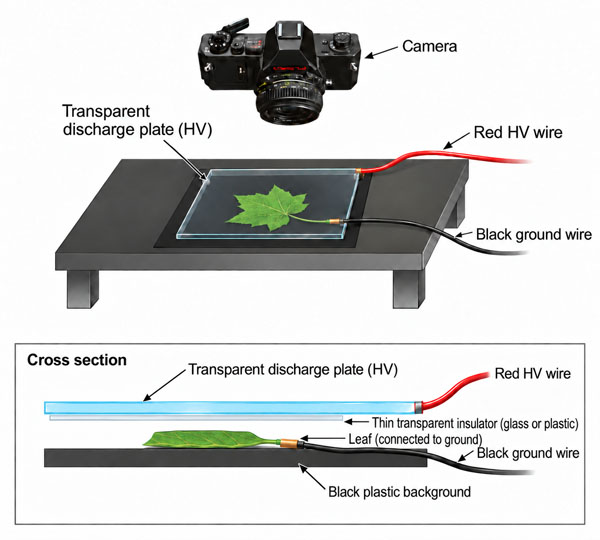
Both methods record the faint light produced when a strong electric field creates a corona discharge around an object. The main difference is how the light is recorded: photographic film captures it on its emulsion, while a digital camera records it through a transparent discharge plate. The exact electrode arrangement varies; in the setups shown here, the high-voltage connection goes to the plate or electrode, and the object is grounded.
Sheet-Film Photography
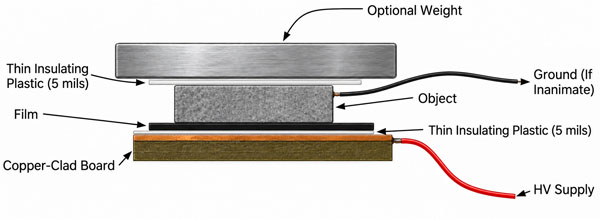
A typical film setup uses 4 × 5-inch sheet film, a conductive electrode plate, thin insulating material, and the object being photographed. In the illustrated stack, 5-mil insulating sheets separate the optional weight from the object and the film from the copper-clad high-voltage electrode. The object is connected to ground.
The setup is assembled in dim light or darkness to keep ambient light from exposing the film. A brief high-voltage exposure, lasting a few seconds, produces the corona discharge, and its light exposes the film. After the power is switched off, the film is placed in a light-tight holder and sent for processing. More details on the sheet-film method are in the Resources section.
Digital Photography
A digital setup uses a transparent discharge plate connected to a high-voltage source, with the object placed on the plate. In the example shown, the object is grounded, and a camera is positioned above the plate.
The camera is composed and focused while the room is lit. The room lights are then turned off, and the camera shutter is opened for a long exposure. The high voltage is applied briefly to produce the discharge, then switched off before the shutter is closed. The lights can then be turned back on; the resulting image is stored in the camera.
These descriptions explain the imaging process; they are not instructions for constructing or operating high-voltage equipment. A high-voltage supply can cause serious injury, even when designed to limit current. Follow the equipment manufacturer’s safety instructions.
5. What Equipment Is Needed, and What Safety Precautions Are Required?
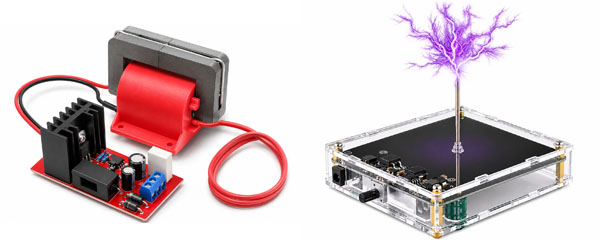
The equipment depends on how the photograph is made. Sheet-film photography uses photographic film, electrodes, and insulating layers. Digital photography requires a camera and a Transparent Discharge Plate (TDP) through which the camera records the discharge. Both methods require a high-voltage power source suitable for the setup.
Suitable high-voltage sources include power supplies designed for Kirlian photography and general-purpose high-voltage supplies, such as small Tesla coils sold online. John Iovine recommends a power supply that provides an output voltage in the range of 3,000 to 10,000 volts or higher at a very low output current of 1 mA or less. These are guidelines from John’s experience, not universal requirements or guarantees of safety.
Power Supplies to Avoid
Do not use neon sign transformers, stun guns, or any high-voltage power supply capable of delivering more than a few milliamps. Neon sign transformers commonly deliver 20 to 30 mA, well above the low-current level recommended for Kirlian photography. Stun guns are designed to deliver electric shocks and are not suitable power sources for this application. Check a supply’s rated output current as well as its voltage.
Suitable Power Supplies
Small Tesla coils and high-voltage supplies listed on AliExpress or Amazon are examples of high-voltage power supplies available to buyers. Iovine has not tested these specific power supplies. Based on the specifications in their product listings, he considers them suitable for Kirlian photography. Unfortunately, the product manufacturers are probably not familiar with Kirlian photography and would not be able to advise on the suitability of their power supplies for that application. Therefore, when considering a high-voltage supply, you should consult its manufacturer regarding safety. Specifically, ask the manufacturer the impact on you if you inadvertently touch the HV lead and shock yourself. Many Tesla coils for sale on Amazon and AliExpress have product listings that show users touching the high-voltage streamers with their fingers.
https://www.amazon.com/Color-Bluetooth-Music-Plasma-Desktop/dp/B0GWM6KTNZ
https://www.aliexpress.us/item/3256809822783964.html
https://www.aliexpress.us/item/3256812386978023.html
All high-voltage equipment can cause serious injury or death. John Iovine uses 1 mA or less as a personal guideline for keeping output current low enough for him to consider the power supply to be safe. The saying “voltage doesn’t kill, current does” is again John’s own personal guide, not a safety guarantee. As OSHA explains, shock severity depends on the amount of current, its path through the body, how long it flows, and its frequency.
Follow the equipment manufacturer’s safety instructions, and do not operate or modify equipment unless you are qualified to do so.
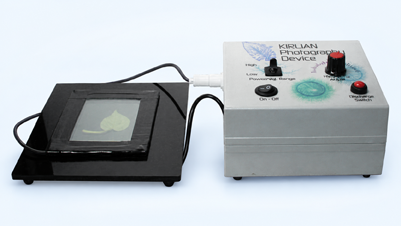
Images Scientific Instruments also offers its own high-voltage power-supply kit and Kirlian photography equipment.
6. How To Shoot Kirlian Photographs
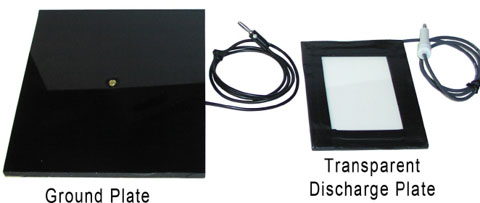
This Kirlian photography setup uses a Transparent Discharge Plate (TDP) and a ground plate. These components simplify the setup and make it easier to create Kirlian images.
The setup can be used with a digital camera, a 35mm film camera, an iPhone, or a low-lux video camera. I’ll describe it using an iPhone, but the other camera types can also be used.
The ground plate is important for shooting inanimate objects, like metal keys, gears and leaves.
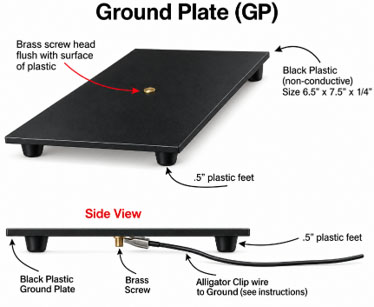
You can place the object in the center of the ground plate, and it will connect to the ground without attaching a wire.
Digital Camera Features
A digital camera needs four features for this process:
- Long exposure: The camera must be able to take exposures of ten seconds or more. Some higher-end cameras have a “Bulb” or “B” setting that keeps the shutter open while the shutter button is pressed. A long exposure gives the faint light from the electrical discharge time to register.
- Macro setting: Macro focus lets the camera focus close to the subject. It is useful when photographing small objects, such as coins and leaves.
- Manual focus: Manual focus lets you focus on the subject with the room lights on, before turning them off. This helps the camera capture the faint light from the corona discharge.
- Flash control: If the camera has a built-in flash, you need to be able to turn it off for the exposure.
Using an iPhone
The iPhone camera I use is less sensitive in low light, so I use an exposure of 10–15 seconds. I use an app called “MagicShutter,” which lets me lock the focus on the object and set the shutter speed manually. With this app, I can set the shutter speed to keep the shutter open for multiple seconds (10-15) for a long exposure.
Keeping the Camera Steady
The camera must stay steady during a long exposure to avoid a blurred image. A tripod or copy stand can hold it in place. I use a copy stand with the ground plate, object, and TDP beneath the camera.
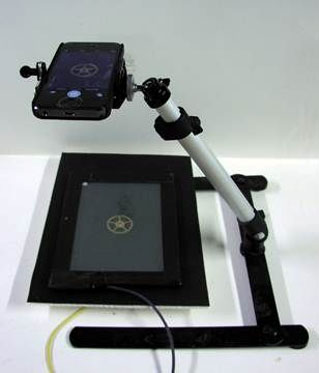
Setting Up the Object and TDP
If the subject is inanimate, place it directly on the grounded black plate. The plate provides the ground connection, so you do not need to attach a ground wire directly to the object. Place the TDP on top of the object and connect the high-voltage power source to the TDP.
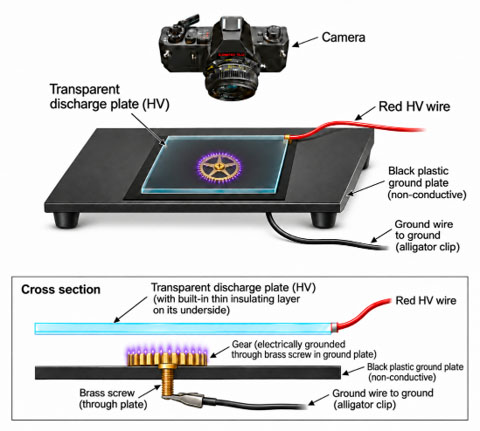
Work Flow
With the room lights on, position the camera and manually focus on the object through the TDP.
Turn on the high-voltage power source and check whether the corona discharge is visible around the object. Room lights can make the faint discharge harder to see, so turn them off briefly if you need a clearer view.
Make the exposure in near darkness. You can use a windowless room with the lights off, block light coming through windows, or shoot at night. Another option is to cover the camera, subject, and TDP with a light-tight black cloth.
With the lights off, turn on the HV power supply and trip the camera shutter for a timed exposure of 10–15 seconds.
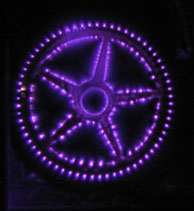
When the exposure is complete, turn off the high-voltage power source and turn the room lights back on. The camera should have recorded the Kirlian image.
6. Why Do Kirlian Images Vary?
The discharge image can change with the subject’s conductivity and moisture, its pressure against the plate, any air gap, the exposure time, humidity, voltage, and frequency. Color film may show colors that were not present in the visible discharge because the discharge can affect the film’s dye layers. Digital cameras generally record the visible blue-violet discharge, though image-editing software can alter or enhance its colors.
7. What Is the Phantom-Leaf Effect?
The phantom-leaf effect is a reported Kirlian image in which a discharge pattern appears in the area where part of a leaf has been cut away. A published replication reported this appearance in some of the leaves it tested, but the observation alone does not establish that an invisible biological structure remains. Moisture and other surface conditions can alter discharge patterns, so further controlled testing is needed to establish what causes the effect.
8. Does Kirlian Photography Show an Aura or Life Force?
The word “aura” is often used to describe the glow or pattern around an object in a Kirlian photograph. The image shows a corona discharge whose appearance can change with physical conditions such as moisture and pressure. It does not by itself demonstrate that a soul, life force, or paranormal energy has been photographed. Such interpretations go beyond what the image establishes.
9. Can Kirlian Images Reveal Health or Emotion?
A Kirlian image can vary with physical conditions, including moisture on the skin. Stress, fatigue, illness, or alcohol may affect a person’s skin or moisture levels, but a change in the image cannot identify which factor caused it or diagnose a condition. Kirlian photography should not be used as a substitute for medical assessment. Any scientific claim about health or emotion would require controlled studies and repeatable results.
10. How Is Kirlian Photography Different from Modern Aura Photography?
They are different methods. Kirlian photography records light from an electrical discharge around an object. Some modern aura portrait systems combine an ordinary portrait with colors generated from readings taken by hand sensors. The two methods create different kinds of images; calling an image an “aura” does not establish that it depicts a spiritual energy field.
11. How Is Kirlian Photography Used in Art and Scientific Study?
Kirlian photography can be used to make artistic images and visual effects. It can also be used to study how corona-discharge patterns change under controlled conditions, such as when moisture or electrical settings change. Scientific conclusions require careful controls and results that other researchers can reproduce. The images are visually striking, but by themselves they do not demonstrate paranormal effects or provide medical diagnoses.